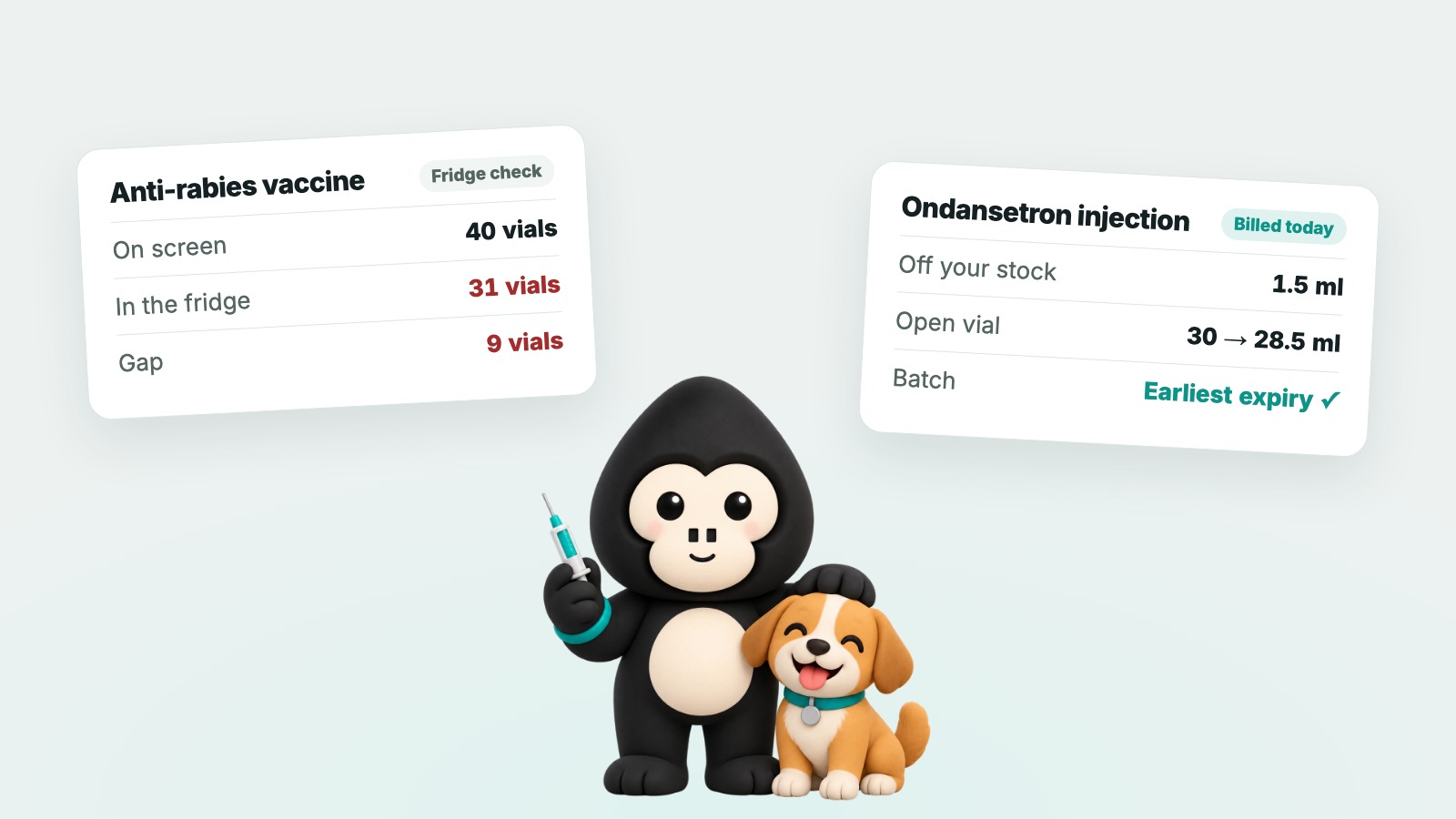
Count the anti-rabies vials in your fridge and compare the number with what your software says. In many clinics the two don't match, and the gap only grows. The software isn't wrong, exactly. It just never heard about most of the vials that left.
The reason is how injections and vaccines are billed. This guide covers why the gap happens, how to decide what to bill as a service and what as a product, how to price a service that uses medicine, how to handle multi-dose vials, and a ten-minute weekly check that keeps the fridge and the screen in step.
Why the fridge never matches the screen
When a pet parent buys a strip of tablets, the front desk bills a product, and stock goes down by one strip. When a vet gives an injection, the clinic bills a service, such as "Anti-rabies vaccination" or "Injection charges". The pet parent pays for the act of giving it, which is right. But the vial the vet used never leaves stock.
Do that thirty times a week and the numbers drift apart. It costs the clinic in three ways:
- Late reorders. The screen says there are plenty of vials, so nobody orders, and the clinic runs out on a busy Saturday.
- Surprise expiries. Stock that exists only on screen can't expire in the fridge, so real expiries go unnoticed until the count.
- Margins that look better than they are. If the medicine inside a service is never counted, its cost never shows up against the service's income.
Service or product? A simple rule
Most clinics argue about this more than they need to. One rule settles nearly every case:
- The pet parent takes it home: bill it as a product. Tablets, syrups, shampoos, spot-ons, food.
- The vet gives it in the clinic: bill it as a service. Vaccinations, injections, dressings, IV fluids, procedures.
The important part is what comes next. Billing an injection as a service doesn't mean the medicine has to go uncounted. The service is what the pet parent sees and pays for; the vial it comes from is what your clinic tracks behind it.
Price the service with the medicine in it
Pricing is your call, and it depends on your costs and your pet parents. A simple way to work out a service that uses medicine:
- The medicine per dose. For a single-dose vial, that's the vial. For a multi-dose vial, it's the vial's cost divided by the doses you actually get from it, after waste.
- The consumables. Syringe, needle, swab, a cannula if one is used.
- Your fee for giving it. The vet's time and skill, which is what the pet parent is really paying for.
Write the three parts down for each service once. When a supplier's price changes, you'll know which services need a new price, instead of finding out from your margins months later.
Count what's worth counting
Not every item needs to be tracked to the last unit. Counting cotton and spirit costs more time than it saves. Focus on:
- Vaccines. High value, short shelf life, and kept in a fridge that's easy to count.
- Injectables. Antibiotics, anti-emetics, painkillers, steroids.
- Costly consumables. Cannulas, IV sets, surgical items that cost more than a few rupees each.
Everything else can be bought as a general expense and checked by eye.
Multi-dose vials: count in ml
A 30 ml vial of an anti-emetic might cover twenty pets. If your stock counts it as "1 vial", it shows the same number until the vial is empty, then drops all at once. That's no help when you're deciding whether to reorder.
- Know the vial size for every multi-dose injectable, and record it with the product.
- Count an open vial as part of stock. "3 vials and 13.5 ml open" tells you far more than "3 vials".
- Follow the label's in-use period after opening. Once that period is over, discard the rest and record it, so the waste is visible.
Use the earliest expiry first
When the same vaccine arrives in two batches, use the one expiring first. It sounds obvious, but in a busy clinic the vet takes whichever vial is at the front of the fridge. Keep the earliest-expiring batch at the front, and make sure your stock deducts from that batch too, so the screen and the fridge agree on which vials are left.
When a bill changes
- A voided bill should put the stock back. If the vaccination didn't happen, the vial is still in the fridge.
- A pet parent who brings their own vial: bill the service for giving it, and don't take anything from your stock.
- The vet used a different product from the usual one: change it on that bill, so the right item goes down.
A ten-minute weekly fridge check
Pick a quiet time each week, the same day every week, and:
- Count five high-value items: two vaccines and three injectables you use the most.
- Compare each count with the stock on screen.
- For any gap, look at the week's bills for that item. A gap usually points to an injection billed without taking the vial off stock, a voided bill, or a vial opened and not recorded.
- Fix the cause, not just the number.
After a few weeks, the gaps get small enough that the check takes five minutes.
Your first month: a checklist
- List the services that use medicine: vaccinations, injections, dressings, fluids.
- For each one, note the product and how much one service uses.
- Record the vial size of every multi-dose injectable.
- Work out each service's price from medicine, consumables and your fee.
- Do a full count of the fridge and the injectables shelf to start clean.
- Start the ten-minute weekly check.
How Koko helps
On Koko, every vaccine and injection you bill comes off your stock by itself. You set up once what each service takes and how much, a whole vial or a few ml from a multi-dose vial, and Koko deducts it from the batch expiring first. A bill is never blocked when stock runs short; Koko flags it instead. Staff can change the product on a bill, or skip the deduction when a pet parent brings their own vial. Voiding a bill returns the stock, and the stock ledger shows every item used in a service.
The pet parent's bill doesn't change: they still see the service they paid for.
Our short video shows it in thirty seconds: Every injection you bill, counted. Want to set it up for your clinic? Book a free demo.
Frequently asked questions
Does the pet parent see the medicine on the bill?
Not unless you bill it as a separate product. The injection shows on the bill as the service, at the service's price.
What if a vial runs out halfway through the day?
Bill the service as usual. In Koko the bill goes through and the shortfall is flagged, so you can check the count and reorder.
Who sets up what each service takes from stock?
An admin or the owner. Front-desk staff can see it but don't change the setup.
Should consultations take anything off stock?
Only if something is used every time, such as a disposable thermometer cover. For most clinics, consultations don't need it.
Ready to Modernize Your Clinic?
Discover how Koko can streamline your operations and enhance pet care.
Schedule a Free Demo